Hey everyone, how’s it going? Today we’re going to explore two container-orchestration giants: Docker Swarm and Kubernetes. If you’re in the DevOps or development world, you’ve definitely heard these names. But which one is the better pick? Let’s break each one down in detail to help you decide.
Understanding Container Orchestration
First things first — it helps to know what “container orchestration” actually means. Imagine you built an application made up of several microservices: authentication, payments, notifications, and so on. Each microservice lives in its own container, and those containers need to “talk” to each other, stay up and running, and scale with demand. Doing all that manually? Impossible. That’s why we have orchestrators like Docker Swarm and Kubernetes that automate these operations and keep everything working in harmony.
Docker Swarm: Practicality and Simplicity
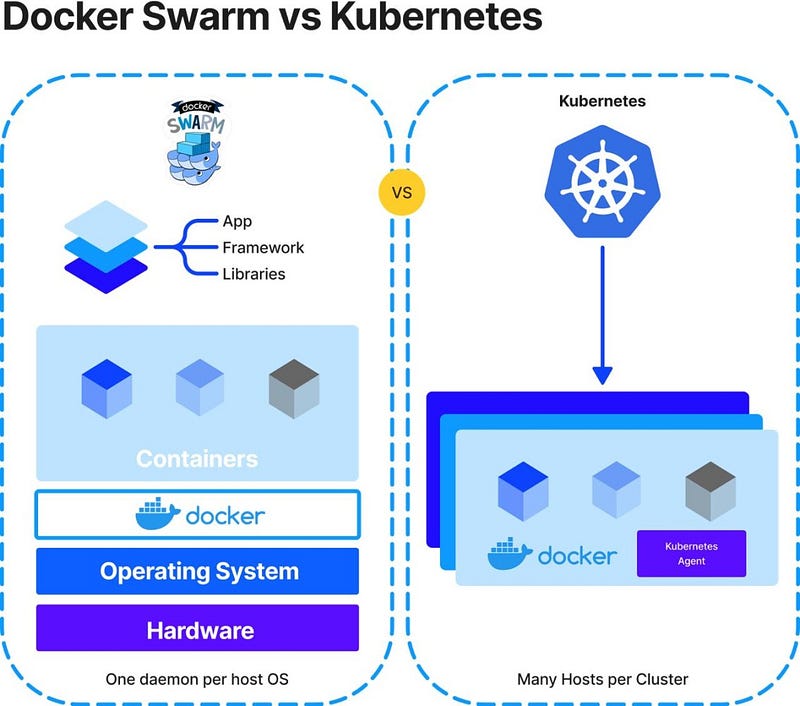
Docker Swarm is a native Docker solution, which means if you already work with Docker, you’re basically one step away from setting up Swarm. It lets you turn multiple Docker hosts into a centrally managed cluster, enabling practical distribution and scaling of containers. Swarm is perfect for companies and projects looking for fast container implementation and administration, without giving up interesting features like load balancing, scaling, and service replication.
With Docker Swarm, you can configure clusters and launch services quickly, all with a pretty intuitive command line. That said, it can be a bit limited on more advanced features — which is what leads us to Kubernetes.
Kubernetes: The Power of Scalability
Kubernetes was originally developed by Google and is now maintained by the Cloud Native Computing Foundation (CNCF). Kubernetes is practically synonymous with enterprise-scale container orchestration. It’s widely adopted by large companies that need a robust solution capable of managing infrastructure in a completely autonomous and intelligent way.
With Kubernetes, you don’t just orchestrate containers — you can also implement autoscaling policies, rollback, update deploys, self-healing, and much more. That means Kubernetes can have your containers reconfigure themselves automatically when one of them fails, keeping the system available around the clock. Of course, all that complexity comes with a bigger learning curve — don’t expect to set everything up in a few minutes like with Docker Swarm. With K8s, it’s more about going deep to reap the benefits in the long term.
Docker Swarm or Kubernetes? How to Choose?
The choice between Docker Swarm and Kubernetes depends a lot on your project’s needs and your team’s level of expertise. Here are a few points to help you decide:
Simplicity vs. Complexity: Docker Swarm is easy to set up and has immediate integration with Docker. Kubernetes, in turn, has more features and flexibility, but takes more time to master.
Scalability: If your system is going to grow at large scale, Kubernetes offers better support for advanced scalability.
Automatic Recovery: Kubernetes has native self-healing features that are useful in high-availability environments, while Docker Swarm requires more manual work in this area.
Maintenance and Monitoring: Kubernetes is better suited to complex environments with high demand for monitoring and advanced networking and security policies.
The tip is to think long-term. If the project is likely to grow substantially and become critical, Kubernetes may be the ideal investment. But for a smaller or early-stage system, Docker Swarm can be a more practical choice.
CloudScript: Your Ally for Digital Transformation with Kubernetes. Here at CloudScript, we’re Kubernetes specialists and we’re ready to help your company on this modernization journey! With our experience in cutting-edge technologies, we offer consulting and solutions that align with your needs and goals.
Our team of specialists can support you in implementing DevOps practices and optimizing cloud environments, bringing security, performance, and scalability to your project. Want to know more? Let’s chat and discover together how CloudScript can take your infrastructure to the next level!
See you around!
 Viviane Coutinho
SEE ALSO
Viviane Coutinho
SEE ALSO