Imagine your company is growing fast. New products, new markets, more people. With growth comes a silent problem: communication slows down, decisions take longer, and innovation stalls. That's exactly the scenario that pushed Amazon to create one of the most studied organizational models in the tech world: the Two-Pizza Teams.
What are Two-Pizza Teams?
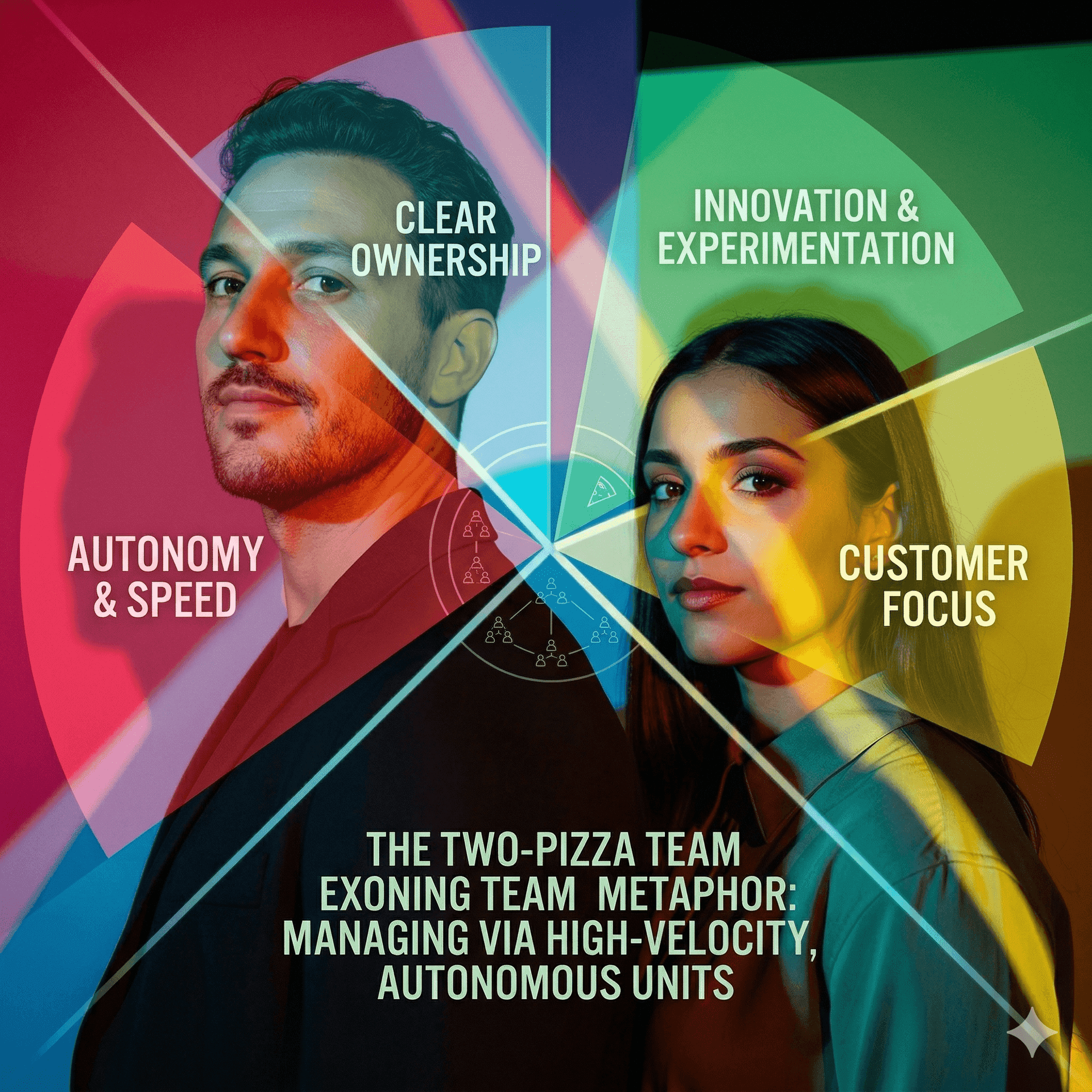
The concept is elegantly simple: a team should be small enough to be fed by two pizzas — ideally fewer than 10 people. But behind this seemingly trivial rule lies a deep philosophy about how to organize engineering teams to maximize speed, ownership and innovation.
Jeff Bezos introduced this model in Amazon's early years, when he noticed that bigger teams didn't mean more productivity. The opposite was actually happening: the larger the team, the more time was spent on meetings, alignment and internal coordination — and less time was left to solve real customer problems.
The Ringelmann Effect: why smaller teams deliver more
The scientific basis for Two-Pizza Teams is the Ringelmann Effect, a phenomenon documented since 1913 that shows how individual productivity drops as the group grows. In a team of 3 people, each individual puts in nearly 100% effort. In a team of 20, that number falls drastically.
There are two reasons:
- Coordination loss: with more people, communication lines grow exponentially (the formula is
n(n-1)/2). A team of 6 has 15 communication channels; a team of 12 has 66. - Motivation loss: when your individual contribution gets diluted in the whole, the sense of responsibility shrinks. It's easier to "coast" on other people's work.
Research shows that organizations with fewer than 10 collaborators per team reach engagement levels above 42%, compared to less than 30% in larger teams. Individual contributions become more visible and meaningful.
Single-Threaded Ownership: the secret ingredient
The real power of the model goes beyond size. The most transformative element is the concept of Single-Threaded Ownership — each team has clear, undivided responsibility for a specific domain.
That means:
- The team is end-to-end owner of its service: development, deploy, operation and support.
- There's no diffuse responsibility — if something breaks, the team knows it owns it.
- Decisions are made inside the team, without waiting on committees or other groups.
- The team lead is "single-threaded": their entire focus is that one domain.
In practice, this eliminates the biggest bottleneck of traditional organizations: dependency between teams. When one team has to wait on another to ship a feature, the speed of both drops to the lowest common denominator.
From monolith to microservices: the technical transformation
The Two-Pizza Teams organizational model didn't emerge in isolation — it evolved alongside a radical technical transformation. Amazon migrated from a tightly coupled monolithic architecture to microservices, and that shift required a parallel restructuring of the organization.
The famous Conway's Law explains why: "Organizations that design systems tend to produce designs which are copies of the communication structures of those organizations." In other words, if you want a decoupled microservices architecture, you need decoupled teams.
Each Two-Pizza Team became the owner of one or more microservices, with well-defined APIs as contracts between teams. This allowed hundreds of teams to evolve their services independently, with no centralized coordination.
APIs as contracts
A fundamental aspect of that transformation was the Bezos API Mandate of 2002 — an internal memo that ruled:
- All teams must expose their data and functionality through APIs.
- Teams must communicate with each other exclusively through those APIs.
- It doesn't matter what technology is used: HTTP, gRPC, events — as long as it's an API.
- All APIs must be designed as if they were going to be public.
That decision, made over 20 years ago, is considered one of the most important in Amazon's history — and eventually gave rise to AWS as we know it today.
Fitness Functions: measuring team success
Autonomous teams without clear metrics can drift from the organization's goals. That's why Amazon uses fitness functions — objective, measurable metrics that define each team's success. Those metrics are:
- Customer-focused: latency, conversion rate, NPS, resolution time.
- Automated: collected and reported automatically, no bureaucracy.
- Business-aligned: each team knows exactly how its work impacts the whole.
This creates an elegant balance: maximum autonomy in execution, with clear accountability on results.
Benefits in practice
Companies that adopted variations of the Two-Pizza Teams model — including Spotify (squads), Netflix and several scale-ups — report consistent benefits:
- Faster innovation cycles: small teams experiment, fail and iterate faster.
- More agile decisions: fewer people in the room means less debate and more action.
- Better talent retention: engineers prefer teams where their impact is visible.
- Higher customer responsiveness: the team that builds is the one that operates and listens to feedback.
- Less process overhead: documentation, meetings and approvals are minimized.
Challenges and considerations
The model isn't a silver bullet. Implementing it requires:
- Technical maturity: microservices, CI/CD, observability and automation are prerequisites.
- A culture of trust: leadership has to trust the teams and resist the urge to micro-manage.
- Platform investment: internal platform teams ("platform engineering") are essential so Two-Pizza Teams don't reinvent the wheel.
- Async communication: with fewer meetings, documentation and RFCs become critical.
The "Day 1" philosophy
Two-Pizza Teams are a manifestation of Amazon's "Day 1" philosophy — the idea that, regardless of size, the company must operate with the agility and urgency of a startup. As Bezos wrote in his shareholder letter:
"Day 2 is stasis. Followed by irrelevance. Followed by excruciating, painful decline. Followed by death. And that is why it is always Day 1."
Small teams, with clear ownership and real autonomy, are the mechanism that lets Amazon keep the Day 1 spirit alive even with hundreds of thousands of employees.
How to apply this in your organization
You don't need to be Amazon to benefit from these principles. Start with:
- Audit your team sizes: if any has more than 8-10 people, consider splitting.
- Define clear ownership: each service/domain should have one responsible team.
- Eliminate dependencies: identify where teams get blocked waiting on others and create APIs/contracts.
- Measure what matters: define customer-focused fitness functions for each team.
- Invest in platform: make it easy for teams by giving them deploy, observability and automation tooling.
At CloudScript, we apply these principles every day in the DevOps, SRE and Platform Engineering projects we deliver for our clients. If your organization wants to scale without losing agility, let's talk.
Source and credits
This article was inspired by and adapted from the original content published by AWS:
Amazon Two-Pizza Team — AWS Executive Insights
All content was adapted and enriched by the CloudScript team for an English-speaking audience.