Hey everyone, how’s it going? Today we’re going to talk about Backstage, an open-source platform from Spotify that has been transforming how companies manage tools, services, and infrastructure. If you work with Platform Engineering or IDPs (Internal Developer Platforms), this one is a must-read!
What makes Backstage so special? It centralizes the essentials in a single place, making teams’ day-to-day easier and driving more organization, autonomy, and productivity. Let’s dive into some details and see how this platform can transform your tech operations.
A new approach to Platform Engineering
In Platform Engineering, Backstage creates a centralized, standardized environment where teams can access everything they need in a simple way. It makes it easy to automate processes like CI/CD pipelines and ensures consistency in development with templates and integrations to DevOps and SRE tools. This significantly reduces operational complexity and boosts efficiency.

IDPs redefined with Backstage
As an IDP, Backstage stands out by offering a self-service environment that lets developers kick off projects, manage services, or provision infrastructure on their own. Thanks to its extensible API, you can plug in custom plugins and tools, creating a tailored experience that drives productivity and autonomy.
The power of Plugins
The Backstage plugin ecosystem is impressive, but the real differentiator is building custom plugins. The flexible API lets you integrate specific tools — system monitoring, vulnerability management, or bespoke dashboards. A valuable tip: document your plugins well and avoid unnecessary coupling to keep maintenance simple and enable efficient reuse.
Entity Catalog
The catalog is the heart of Backstage. Have you tried using dynamic YAML support to generate entities automatically? Imagine, for example, integrating CI/CD systems that create new pipelines and add them to the catalog on the fly. On top of that, using tags like owner, team, and lifecycle helps you organize and supercharge search and reporting, especially on larger teams.

Observability integration
Centralizing observability data is one of the biggest wins with Backstage. Tools like Prometheus, Grafana, and Jaeger can be integrated to give you complete views of metrics, logs, and traces in one spot. That not only improves your workflow by cutting down context switching but also makes troubleshooting faster, with quick and accurate insights.
Security and Access Control (RBAC)
As Backstage adoption grows, platform security becomes critical. Implementing role-based access control (RBAC) and robust authentication like OAuth or SAML is a recommended practice. Beyond that, reviewing permissions regularly and checking third-party plugins for vulnerabilities helps mitigate risks.
Automation and CI/CD
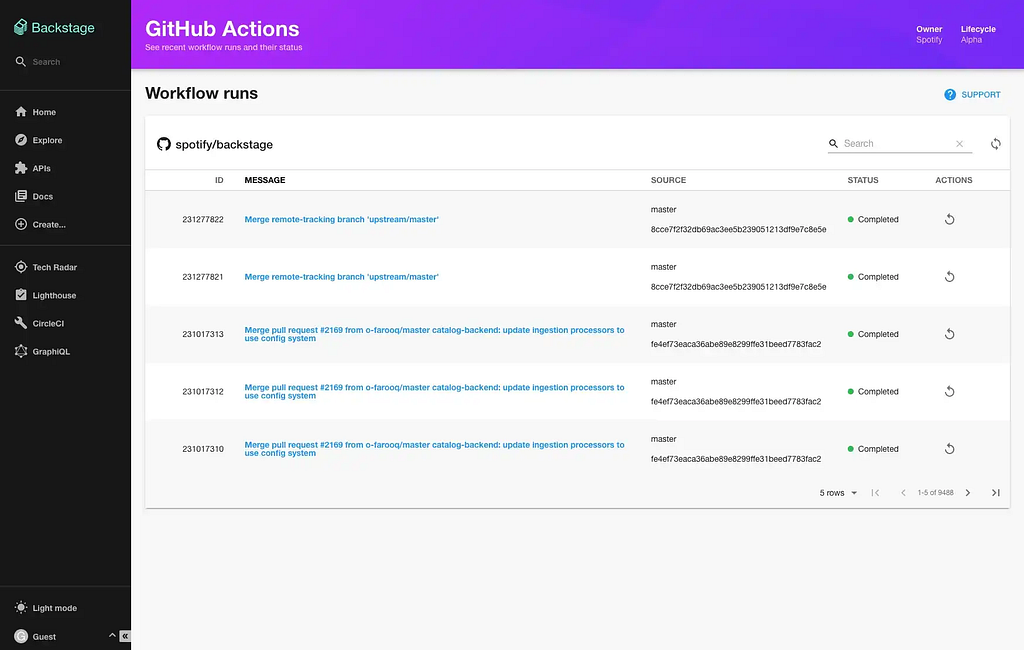
Backstage is a key piece for plugging automation into the development lifecycle. With it, workflows can be triggered right from the interface — deploy pipelines or test runs, for example. Adding buttons that kick off actions or setting up dynamic pipelines based on catalog tags are strategies that save time and reduce operational mistakes.
Scalability and Performance
For large organizations, optimizing Backstage performance is essential:
- Cache: implement caching for frequent GraphQL API queries.
- Database: use PostgreSQL with indexes to speed up searches.
- Load Balancer: distribute requests with load balancers.
The future of Backstage
The Backstage community is constantly evolving. Plugins for Kubernetes keep expanding, making it easier to manage clusters and workloads. Meanwhile, Spotify, the creator of Backstage, keeps updating the documentation and shipping important improvements, including security advances.
So — interested in rolling out Backstage in your organization? At CloudScript, we’re specialists in custom solutions like this one. Get in touch with us and find out how we can help optimize your operations with technology tailored to you.
Enjoyed the post? Make sure to follow us for more insights on technology and innovation!
See you next time!
References:
https://backstage.io/docs/overview/what-is-backstage
https://roadie.io/backstage/plugins/github-actions/
https://engineering.atspotify.com/2020/03/what-the-heck-is-backstage-anyway/
https://github.com/backstage/backstage/blob/master/microsite/static/animations/backstage-logos-hero-8.gif