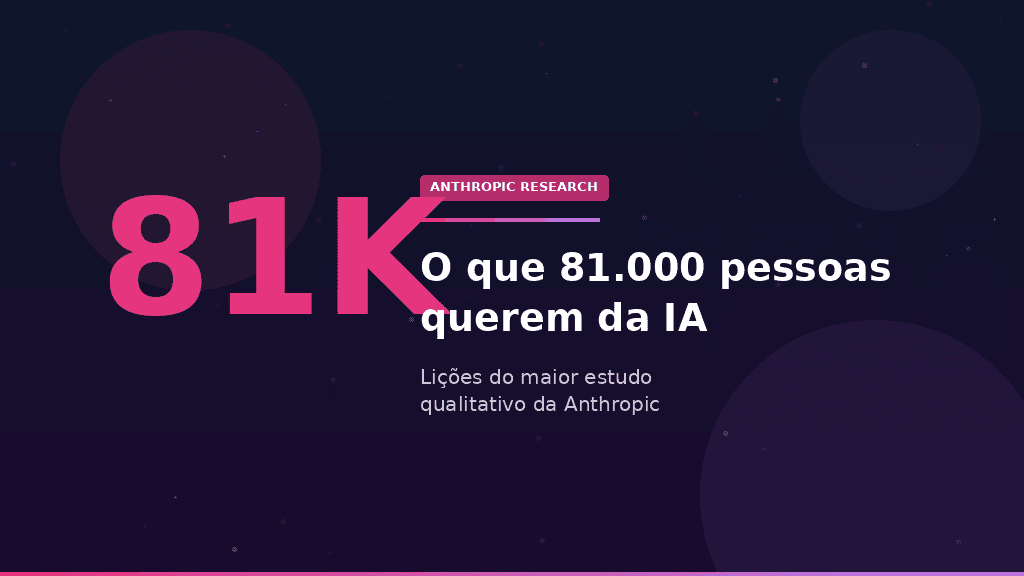
The largest qualitative study on AI ever conducted
In December 2024, researchers at Anthropic pulled off something unprecedented: open-ended interviews with 80,508 Claude users, spread across 159 countries and 70 languages. The goal was simple — understand what people really expect from artificial intelligence.
Led by Saffron Huang, the project used an AI-based classification system to categorize thousands of open-text answers, revealing surprising patterns in how the world sees this technology.
What people want most
Answers about positive visions of AI concentrated on five main themes:
- Professional excellence (18.8%) — Using AI to stand out at work and deliver more value.
- Personal transformation (13.7%) — Learning new skills, growing as a person.
- Life management (13.5%) — Organizing day-to-day tasks more efficiently.
- Time freedom (11.1%) — Automating the repetitive so we can focus on what matters.
- Financial independence (9.7%) — Building businesses, generating income with AI's help.
The results already happening
The most striking data point: 81% of respondents reported real progress in their visions thanks to AI. The main benefits cited were:
- Accelerated productivity (32%) — Getting more done in less time.
- Cognitive partnership (17.2%) — Having a copilot to think alongside.
- Easier learning (9.9%) — Understanding complex concepts faster.
The fears are real — and contradictory
At the same time that they celebrate the benefits, participants voiced serious concerns:
- Lack of reliability (26.7%)
- Economic and job impact (22.3%)
- Loss of human autonomy (21.9%)
- Cognitive atrophy (16.3%)
The study reveals a fascinating tension: the same capabilities that benefit people are the ones that scare them the most. Those who value AI's emotional support are three times more likely to fear becoming emotionally dependent on it.
A global perspective that isn't even
Optimism about AI varies dramatically by region. 67% of global respondents hold a positive view, but enthusiasm is significantly higher in developing countries, which see AI as an economic equalizer.
What this means for those of us who build technology
For DevOps, Platform Engineering and Cloud teams, this study is an important reminder: AI isn't just a technical tool — it's a growing expectation from users. Integrating AI reliably, transparently and usefully into the products we build is no longer optional. It's what 81 thousand people are asking for.